
Create Generative AI Value at Scale
Companies expanding GenAI across the enterprise use new structures like an “AI spine” to coordinate efforts.
Topics
News
- Musk Says Space AI Data Centers Are Within Reach as SpaceX Nears IPO
- TCS Chair Says AI Agents May One Day Match Its Workforce
- OpenAI Files Confidentially for IPO, Keeps Timing Open
- TCS Wins Canada Life AI Services Deal
- OpenAI Adds Lockdown Mode to Limit AI Data Theft Risks
- Gemini Flaw Let Hackers Exploit Android Notifications
Christian Gralingen
GENERATIVE AI presents an organizational puzzle. Businesses have collectively invested billions of dollars to give employees access to general-purpose large language models (LLMs) to enhance personal productivity while in most cases struggling to develop and adopt more strategic applications of the technology. Meaningful return on investment, much less competitive advantage, is likely to remain elusive unless companies can use GenAI to make innovative process improvements that scale across functions and business units.1
Our interviews with 87 practitioners in 23 large organizations revealed that leaders who scale value creation with generative AI cultivate three key practices. First, they expand the scope of use cases across processes rather than remaining focused on a specific task. Second, they treat each use case as a work in progress to be continually improved. And third, they quickly identify and abandon use cases that fail to bring measurable value to the organization.
However, most traditional companies are not structured to institutionalize these three practices. Many operate as multidivisional organizations characterized by multiple profit and loss units with duplicated functions, limited cross-functional information flow, and internal competition for resources.2 This setup makes it difficult to scale generative AI use cases across processes and units.
In our research, we found that the few leaders who are overcoming these challenges are moving beyond the classical hub-and-spoke models that many organizations have used to connect centralized AI technical expertise to each unit. They are developing a new kind of internal resource that we call the AI spine. It provides a flexible core structure for implementing, evolving, and abandoning LLM use cases at scale, keeping the generative AI portfolio both focused and current. Notably, rather than deploying technologists out into business units, as is commonly done, this structure pulls individuals with domain knowledge of business processes into the core and makes them part of the team.
A retail bank that we studied demonstrates the kind of scaling and value creation that an AI spine supports. Initially, the bank’s AI spine spearheaded the implementation of an email assistant for customer service employees. In an early, limited rollout, those using the assistant collectively saved about 700 hours. Once the tool was put into wider use, it reduced email handling time by 15%, allowing employees to dedicate more time to managing complex cases. Encouraged by that success, the spine oversaw the implementation of LLM-powered email thread summaries, call transcriptions, and analyses. That yielded data that provided new insights for customer service employees, leading the bank to start reengineering its approach to customer relationship management. The data was also used to develop the next iterations of the email assistant.
We observed another example at a medical coding company that applies standardized alphanumeric codes to documentation related to diagnoses, treatments, and procedures for the purposes of insurance and health care management. There, the AI spine provided a structure that allowed it to turn its first LLM application for automated coding into a new line of business. An internal LLM application had reduced coding time from 25 minutes per case to 2 seconds, cutting the cost of coding by 60% compared with having humans doing the work. (Affected staff members were able to take on other responsibilities.) The AI spine was able to build out the application into a product for insurance companies that need to verify whether bills have been correctly coded, increasing the company’s reach into the medical insurance market and creating a new revenue stream.
Connecting AI Efforts Across the Enterprise
The AI spine is a cross-functional backbone that is dedicated to diffusing and scaling LLM use cases across the organization, focusing on reducing duplicative efforts and achieving economies of scale as solutions expand across business units and processes. Because it is a central point for collaboration between technologists and those holding business domain knowledge, the spine holds the expertise required for rewiring and continually improving processes end to end and across functions, as in the bank example above. As we found at the medical coding company, this structure can be implemented not only in large organizations but also in small and medium-sized enterprises.
In the cases we observed, funding for the AI spine was allocated by top management, and the spine also got a cut of increased revenue or costs savings resulting from applications deployed. That mechanism creates the right incentives: It forces the organization to measure ROI, stay focused, and avoid disproportionate spending on “convenience” use cases that seem useful but don’t materially affect costs or revenue. By being independently funded, the spine maintains decision-making autonomy vis-à-vis other divisions so it can identify and encourage use cases that have the potential to improve processes cutting across divisions. A more traditional AI center of excellence with a hub-and-spoke structure is more likely to focus on cases within individual business units rather than across them.
The spine is overseen by a C-suite leader, who keeps its efforts aligned with overall strategic objectives; this may be a chief technology officer or chief digital officer, or one of their direct subordinates. Sitting within the structure are AI developers, risk and compliance personnel, and a technology owner. (See “The AI Spine.”)
The technology owner is responsible for preventing the fragmentation of data flows and tools. They typically oversee the creation of centralized data platforms, prompt libraries, models, and evaluation and technical performance metrics (including token consumption and financial costs). This oversight reduces rework and lowers marginal costs as applications are diffused across the organization.
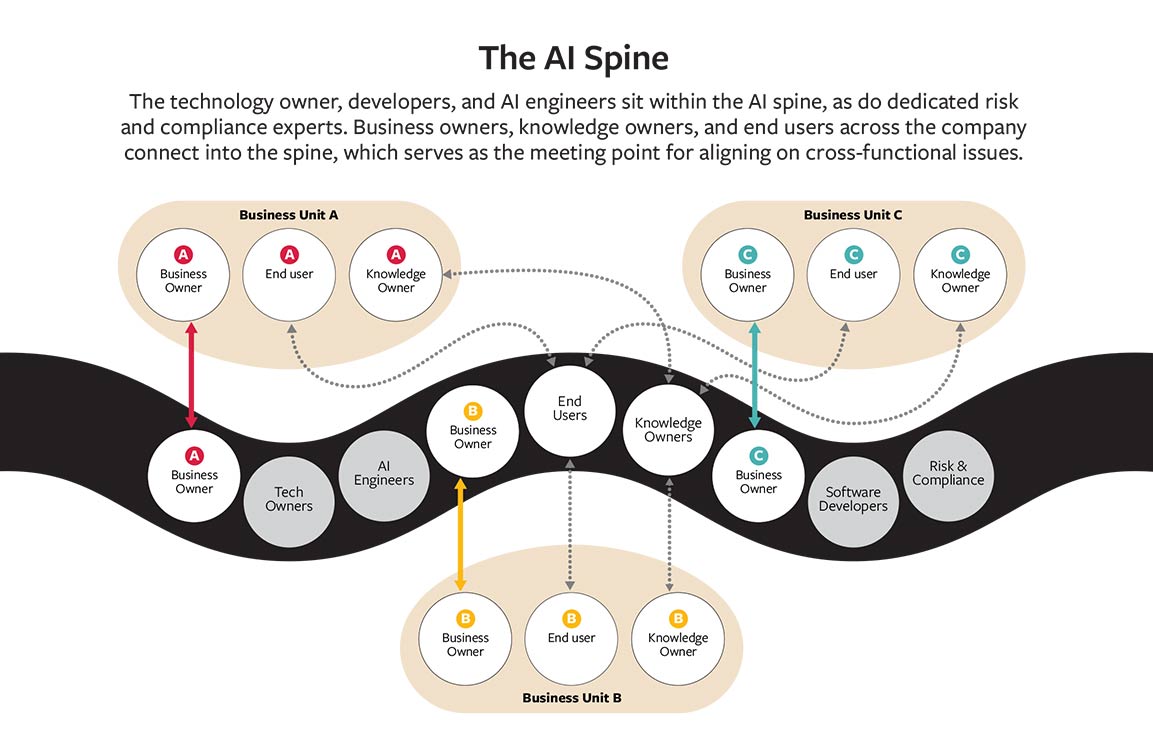
To ensure that risk and compliance are managed throughout each iteration of a use case, the person managing those issues is a permanent fixture in the spine. Making that a permanent role expedites compliance issues and centralizes organizational learning and memory so they can be rapidly applied to other use cases. This means that governance is less ad hoc than it is within other structures for organizing AI work, where a general risk and compliance group sits outside and is often overwhelmed by issues specific to AI.
Sitting within the business units but working closely with the AI spine are business owners, knowledge owners, and designated end users. Business owners — that is, the heads of the business units working with the spine on use cases — are the primary bridge between their unit and the spine. They are responsible for identifying processes where they can make a good use case for GenAI and determining nontechnical baselines and targets (for example, star ratings assigned by end users, where a minimum 3 out of 5 stars would be the goal). They are also accountable for implementing proven use cases for the identified processes and making sure that use cases that underdeliver are dropped. This ensures that proofs of concept don’t stall out or remain confined to a specific business unit. The business owner also enlists representatives from each unit to serve as knowledge owners, and end users who can deliver feedback, to ensure that new applications create real value for the business.
End users provide critical feedback on post-implementation performance, such as identifying edge cases.
Knowledge owners work with the technology owner to ensure that both explicit and tacit knowledge critical to the use case are understood by technologists and captured by the application. They curate ground truth and provide important feedback on the generative AI components that will become de facto repositories for organizational knowledge. Prompt libraries, for example, need to be current with company policies and safety guardrails to generate appropriate responses. Knowledge owners are able to quickly identify issues within their domain, reducing rework and costly escalations as GenAI use cases are implemented and evolve. They also help to rein in GenAI work when a tool’s performance is strong enough from a business perspective, regardless of technical performance. In other words, a solution may not be technically perfect but still good enough that employees find that it makes their work easier.
Select end users of generative AI solutions work with the spine to validate that a use case will be helpful to its intended users. This is important because underperforming use cases lead to low adoption rates, workarounds, and, in some cases, shadow AI. End users also provide critical feedback on post-implementation performance, such as identifying edge cases. Their input drives the next iteration of application improvements.
The AI spine serves as a central point for short standup meetings that are held regularly, perhaps every other week. At the bank, spine members use the meeting to share lessons learned, discuss ongoing and future priorities, and communicate changes that have been made to knowledge repositories, such as prompt libraries. They hold a summit event every month and invite end users to keep them updated with progress, show them demos, and gather their feedback. These events capture needed adjustments during the development process so that applications don’t have to be reworked after they go live. They also help manage users’ expectations and apprehensions.
Pulling the five roles above and the AI developers into a self-contained, highly connected structure helps to effectively align stakeholder interests, ensure that salient knowledge in the organization is contributed where it will have an impact, facilitate collaboration across functions, and more effectively diffuse knowledge and value across business units. Those activities support the key GenAI scaling practices we introduced at the beginning of this article: selecting use cases for implementation; gradually expanding their scope across processes; continuously improving each use case; and taking rapid action on underperforming use cases. The examples below show how the AI spine works.
Respecting Domain Experience and Expertise to Tune Performance
When the bank initially built its email assistant, the effort focused on technical issues, such as integrating information relevant to customer service from the company website and internal documents. While the assistant functioned as designed from a technical perspective, customer service agents were underwhelmed. They reported that responses to customer queries that the application generated were plausible but often incomplete or subtly misaligned with the bank’s standards, and that the tone of the messages was inconsistent. Agents frequently had to modify messages before they were fit to be sent back to customers. Those results underscored the importance of making better use of the tacit knowledge the agents possessed, which wasn’t captured in available data sets. The customer service agents’ feedback gave developers in the spine a foundation for subsequent iterations. Because those end users were represented at regular project review meetings convened at the spine level, and the spine had the authority to veto underperforming releases (while pushing forward when all criteria were met), the company had the opportunity to get the application right.
The AI spine also used mechanisms to surface more tacit knowledge. Customer service employees were compensated for rating each generated response on a scale of 1-5, and their manual edits to those responses were logged for review. This provided critical data to evaluate the performance of the email assistant, creating a feedback loop that surfaced the organization’s unwritten norms regarding tone, intent, escalation thresholds, and edge cases, which can take a significant amount of time to answer. Since then, the bank’s AI spine has routinized the use of ratings and the logging of edits to AI-generated contents as key metrics for other use cases, complementing technical metrics. That practice allows them to identify cases where efforts dedicated to addressing model or prompt shortcomings are likely to generate value, thus focusing human effort where it will be most valuable. For example, the email assistant’s performance was significantly improved when customer service employees shared their knowledge of how customers typically phrase requests.
Unlike AI centers of excellence, which centralize tech know-how, the AI spine centralizes business process knowledge to fuel innovation.
Compensating employees for their efforts and directing them to higher-value tasks reduced attrition and alleviated their concerns about job security. Retaining employees with deep domain knowledge is critical for generative AI because they help curate data, refine and update prompts, and provide feedback on outputs. When GenAI is deployed in a business unit with high employee churn, over time there are fewer people who can confidently validate outputs without having to refer to documentation — a slow process that undermines productivity gains.
The spine structure brings discussion of both technical issues and business issues to a single forum and fosters a common language so that everyone can contribute to a multifaceted discussion of application performance. This played out at the medical coding company, where the coding application initially performed poorly and AI developers saw the problem as a technical issue that could potentially be resolved through additional data collection. However, nontechnical participants in the AI spine reviewed the results and challenged the engineers. On closer inspection, they found that ground-truth labels used to train the model were inconsistent and that the system was, in fact, outperforming human coders. The labeling inconsistencies arose because different groups of coders had differing levels of medical education. Discovering those inconsistencies allowed developers to implement a timely fix in the next iteration of the tool and avoid wasting time and resources training the model on an improperly curated data set.
Accelerating AI Adoption and Aligning Stakeholders Across Processes
Both the bank and the medical coding company set strategic goals for generative AI adoption, but business units were reluctant to directly fund GenAI use cases because of the high degree of uncertainty associated with such initiatives, given the unpredictability and unreliability that foundation LLMs are known for. Ideas would seem promising and sometimes work well on a small scale or as proofs of concept but fail to move further. Establishing the AI spine as a separate entity with a clear connection to executives helped maintain strategic alignment.
At the bank, the AI spine funds use cases across multiple phases through microgrants tied to meeting both technical and nontechnical performance criteria; a similar pattern was observed in the medical coding company. This approach helps build solutions and manage risk incrementally for long-term initiatives. In both companies, the spine acts as a catalyst for achievements and lessons that can benefit all business units. While moving funding decisions for generative AI initiatives away from business units was initially perceived as problematic, over time it resulted in bolder innovation.
Members of the AI spine in each company also realized that process knowledge was highly fragmented. Each business unit had a fairly clear idea as to how its part of a given process worked, but a clear vision of the entire process from end to end across units was missing. The spine championed the mapping of key processes where GenAI use cases had been proposed, involving stakeholders from each business unit until these processes could be drawn accurately. With these representations, they could clearly communicate the scope of use cases and their potential expansion, as well as see GenAI’s applicability across multiple use cases, as illustrated by the creation of a new revenue stream for the medical coding company. Unlike AI centers of excellence, which are primarily geared toward the centralization of technological know-how, the AI spine centralizes business process knowledge to fuel innovation.
Maintain Momentum for Continuous Improvement and Diffusion
The AI spine is set up not to deliver technology solutions to internal customers as in the typical hub-and-spoke arrangement but to codevelop them with business unit representatives and continually refine them based on user feedback and other performance metrics. That means business units are less likely to wind up shelving underperforming use cases that have been delivered by a team that’s moved on to something else.
The bank capitalized on its AI spine’s facility for iterative experimentation and treated generative AI as a constant work in progress. While the email assistant eventually led to significant time savings for customer service agents, getting there took multiple incremental rollouts that continually raised the bar. Clear technical and business performance targets defined an apparent goal at each iteration that determined whether the solution would be rolled out to end users. It also gave teams time to learn progressively and to assimilate new technological developments in a field that evolves quickly. Embedding varying degrees of work automation led to a more granular view of performance. One version of the email assistant was good at extracting information from customer messages, but the voice, tone, and style of its written responses were off. Messages that included a lot of bullet points and overly familiar phrasing felt more culturally attuned to the U.S. market than to the more reserved Swiss culture.
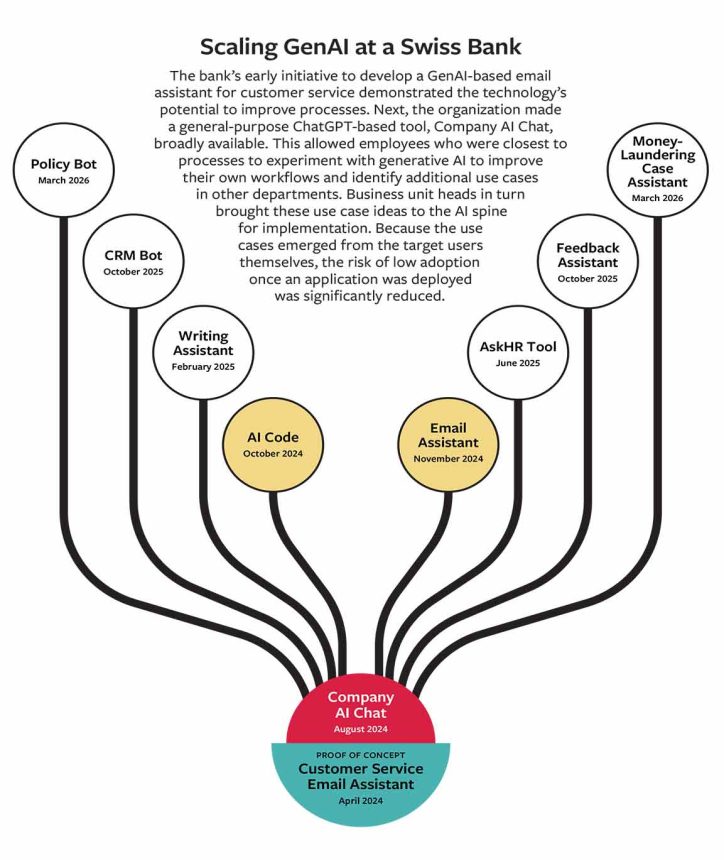
Keeping the momentum to continue innovating with GenAI requires a careful balance between the exploitation of existing use cases and the exploration of new ones. The AI spine’s orientation toward users, and the priority that its structure places on better understanding how employees interact with GenAI across processes, has helped the bank to develop new use cases. (See “Scaling GenAI at a Swiss Bank.”) By studying those user interactions through employee surveys and shadowing sessions, the bank was able to identify eight new potential use cases, two of which have since been deployed alongside the email assistant: the AskHR chatbot, which answers HR-related questions on topics such as employee benefits; and an employee handbook chatbot that responds to employee questions about what is permitted and forbidden in the execution of their jobs.
The Drawbacks of Simpler GenAI Structures
Among the 23 organizations that participated in our research, only two were able to meaningfully scale generative AI to a strategic capability, and both of them had created structures recognizable as an AI spine. While that is an admittedly small evidence base, companies achieving such results are currently in the minority, and we believe that their practices are worthy of close attention.
Building an AI spine requires significant top-level commitment, time, effort, and funding. The other organizations that were part of our research adopted one of two alternative structures — what we’ve termed GenAI units and GenAI squads — that we see as potential building blocks to a more robust capability. They were still able to exploit generative AI to achieve some economies of scale, but the scope of their efforts was narrower, and they faced challenges expanding their use of GenAI.
Thirteen of the organizations we studied set up a standalone, central GenAI unit. These are typically technology-focused and charged with providing solutions to the business units. While often the most feasible approach when resources are constrained, the GenAI unit can quickly reveal its limits regarding business (rather than technical) performance and user adoption. A Swiss health insurer illustrates this limitation. Its generative AI unit tried to roll out an email assistant for its customer service center agents. The model could produce fluent replies, but compliance specialists, consulted only after the pilot, pointed out that every customer message had to follow tightly regulated text templates. Fearing noncompliance, customer service center agents reverted back to approved texts, and so adoption plateaued and the project stalled. Without a mechanism to coordinate work across multiple functions (in this case, risk, legal, and customer service), the bank was left with a zombie GenAI use case with no clear path forward. This early failure increased organizational skepticism toward generative AI, making it increasingly difficult to garner support for future use cases.
A stand-alone GenAI unit can be useful for the early, exploratory stages of the technology: It concentrates talent and lets the organization explore GenAI’s potential before committing major resources. However, it cannot properly assess the specific needs of each unit or coordinate work across multiple use cases, and it lacks an end-to-end view of processes that could be improved with GenAI.
Another approach, taken by eight organizations in our study, is to embed small, cross-functional GenAI squads within each business unit. The companies using GenAI squads were able to take ideas to working pilots much more quickly than those using GenAI units, because they were better able to harness relevant business know-how and faced fewer coordination challenges. However, the squads struggled to manage use cases at various levels of maturity. A Swiss insurer’s GenAI squad launched a customer-facing chatbot for product information in record time. Just a few weeks later, curious users prompted the chatbot to recommend pizza recipes. That incident led to multiple iterations aimed at hardening the system — and revealed how rolling out the initial implementation of a generative AI solution is often easier than maintaining and improving it. As the portfolio of use cases expanded, the mounting maintenance burden of updating data sources and prompts stretched the GenAI squad to its limits, leaving little capacity for pursuing new use cases.
Because GenAI squads are funded and staffed by the business units, they can lead to inequities and inconsistent technology adoption at the enterprise level. Some units have the means to fund multiple use cases and hire their own staff. Others must lower their expectations, regardless of the potential value of a use case. This structure perpetuates silos and duplicative efforts; the lack of an end-to-end view of business processes limits value creation at the organizational level. GenAI squads can help to quickly spread generative AI adoption within the organization, but leaders need a different approach if their goal is to coordinate GenAI use cases across the organization.
Creating value at scale with generative AI does not come from giving everyone access to an LLM and hoping that something magical will happen.
Instead, we advise leaders to begin by creating and visibly supporting a small, cross-functional AI spine that can coordinate across business units. The spine should be charged with standardizing and centralizing core building blocks (processes, data, evaluations, prompts, and models).
That mandate must be matched by financial resources. Central funding is essential because it enables the spine to pursue cross-business-unit opportunities that no single business unit alone would sponsor. In addition, executives must define early on what “value” means, to help identify underperforming use cases and normalize dropping them.
Finally, while creating value at scale with GenAI initially depends on a top-down decision by business leaders, sustaining and expanding that value over time depends on continued contributions from business units. Executives should empower and expect the AI spine to convene the technology owner, risk and compliance, business owners, knowledge owners, and end users in continuous collaboration so that their respective expertise can be combined to surface and capture tacit knowledge, align performance with real operating standards, and ensure that improvements compound rather than stall after the pilot phase.
REFERENCES (2)
1. M. Wade, K. Trantopoulos, M. Navas, et al., “How to Scale GenAI in the Workplace,” MIT Sloan Management Review, July 8, 2025, https://sloanreview.mit.edu; and E. Mollick, “Reinventing the Organization for GenAI and LLMs,” MIT Sloan Management Review, April 2, 2024, https://sloanreview.mit.edu.
2. P. Reineke, R. Katila, and K.M. Eisenhardt, “Decentralization in Organizations: A Revolution or a Mirage?” Academy of Management Annals 19, no. 1 (January 2025): 298-342, https://doi.org/10.5465/annals.2022.0206.