


Tata Vows $11 Billion for Innovation City Near Navi Mumbai Airport
The $11 billion commitment positions Innovation City as a test case for Maharashtra’s bid to anchor AI and semiconductor investment at scale.
News
- Fired OpenAI Researchers Warn Dismissals Could Chill Safety Work
- ARTEX Developer Closes AI Hacking Tool After Bank Attacks
- AI Redraws Global Race for Quant Talent as Coding Tools Lower Entry Barriers
- AI Dispatch | India Draws Billions Into AI
- AI Bots Now Make Up Half of Traffic to US Fed’s FRED Database
- Musk Blames ‘Oligarchs’ For Delay in Starlink’s India launch
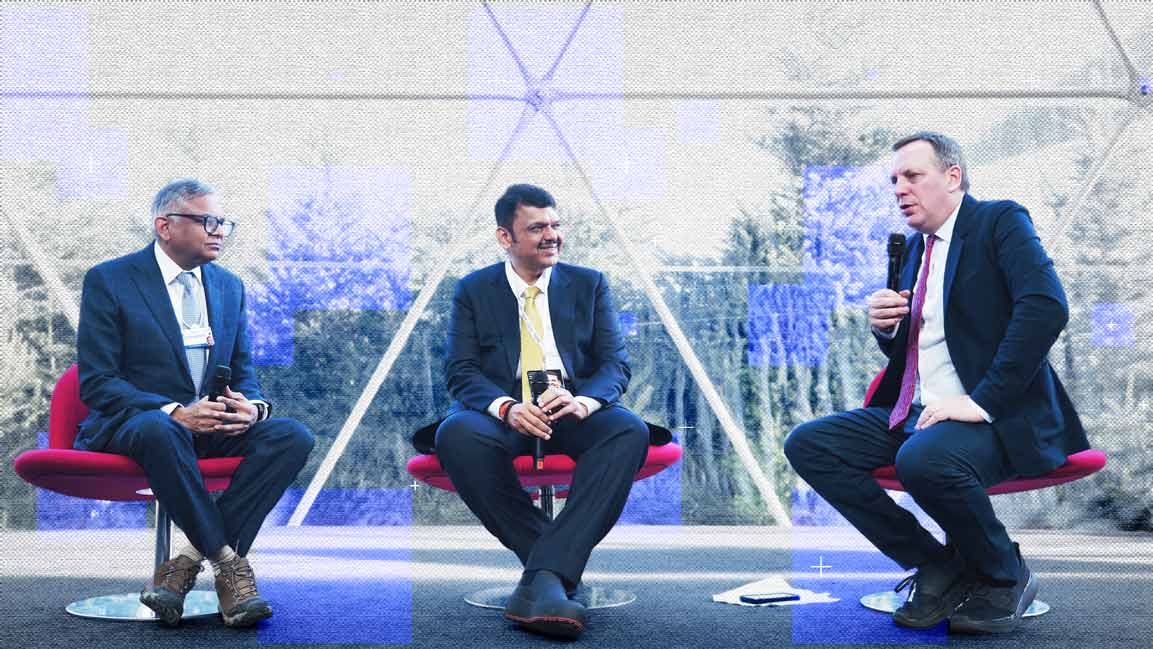
The Tata group has committed about $11 billion (roughly ₹91,000 crore) to build an Innovation City near the Navi Mumbai International Airport, part of Maharashtra’s strategy to position itself as a global hub for artificial intelligence, semiconductors and next-generation technology industries, state officials said.
The announcement was made on the sidelines of the World Economic Forum (WEF) Annual Meeting 2026 in Davos, Switzerland, where the project was unveiled to global investors.
Chief Minister Devendra Fadnavis described the Innovation City as a “plug-and-play innovation system” that would make Mumbai accessible to innovators and enterprises from around the world.
“Our goal is to make Mumbai a hub where anyone in the world can easily access a plug-and-play innovation system,” he told news agency ANI.
Fadnavis said the concept was first introduced under the AI and Innovation Ecosystem theme at the 2025 WEF and that the location has now been finalized, with work expected to begin within the next six to eight months.
A New Innovation Hub
Situated adjacent to the Navi Mumbai International Airport, a major new aviation gateway for the Mumbai metropolitan area, the Innovation City is being framed as one of India’s first dedicated innovation ecosystems of this scale.
Fadnavis said that international investors have responded positively to the announcement since it was made in Davos. Presentations to more than 400 global investors in past forums laid the groundwork for the broader push to institutionalize innovation infrastructure in Maharashtra, he noted.
Tata Sons’ commitment, anchored in largescale infrastructure investment, has attracted further interest from global firms considering establishing operations in the region.
The development at Davos comes as Maharashtra also secured a broad set of memoranda of understanding (MoUs) covering infrastructure, industry and technology deals worth an estimated ₹30 trillion (about $360 billion), aimed at generating around 3 million jobs across the state. The Innovation City anchors this investment portfolio as a flagship initiative in the technology domain.
Mumbai 3.0 and Beyond
The Innovation City initiative dovetails with Maharashtra’s broader economic ambitions, including the evolution of new business districts and smart cities in the Mumbai Metropolitan Region.
Projects such as the Raigad-Pen Smart City, modelled on established commercial hubs like Bandra-Kurla Complex (BKC), and other “Third Mumbai” development plans aim to decentralize economic activity and create new growth centers around the Navi Mumbai airport and surrounding corridors.
By integrating research, industry and global connectivity, the state government portrays Innovation City as part of “Mumbai 3.0,” a vision of the metropolitan region as a world-class economic and innovation gateway. This complements ongoing efforts to attract foreign direct investment, expand data center capacity, and build local capabilities in advanced manufacturing and digital services.
The push for an innovation hub also aligns with broader national imperatives. India has articulated ambitions to emerge as a global leader in artificial intelligence, cloud services and semiconductor ecosystems, sectors that are central to the so-called Fourth Industrial Revolution.
Data infrastructure, a core pillar of the Innovation City, is attracting heavy investment worldwide. Consultancy McKinsey & Company has estimated that global demand for data center capacity could more than triple by 2030 compared with 2023, a trend that makes regions with strong connectivity and skilled workforces particularly attractive for global tech firms.
While the Innovation City has generated enthusiasm among policymakers and industry stakeholders, translating vision into reality will require navigating several challenges. These include securing the necessary regulatory clearances, ensuring seamless integration with broader urban planning frameworks, building enabling infrastructure such as power and digital networks, and fostering a talent ecosystem that can sustain high-technology operations.
Moreover, sustained global interest will depend on India’s ability to maintain competitive policy frameworks, including ease of doing business, intellectual property protections and incentives for research and development. Maharashtra’s government has signaled an intention to partner closely with industry players, including Tata Sons, to address such structural bottlenecks.