

Education Ministry Brings AI Into Classrooms From Class III
The CBSE curriculum will be introduced for Classes III to VIII from the 2026-27 academic session.
Topics
News
- Cisco Warns Critical Email Gateway Flaw Under Active Attack
- Bank of America Hires 1,000 Contractors as AI Raises Cyber Costs
- Netflix Cuts About 1,000 Jobs in Biggest Layoff Since 2022
- Indian Embassy in Jakarta Launches AI Avatar Dewi
- Anthropic Tests How Small AI Models Can Replicate Across IoT Devices
- Scientists Call for Global Oversight of Cyber-Capable AI
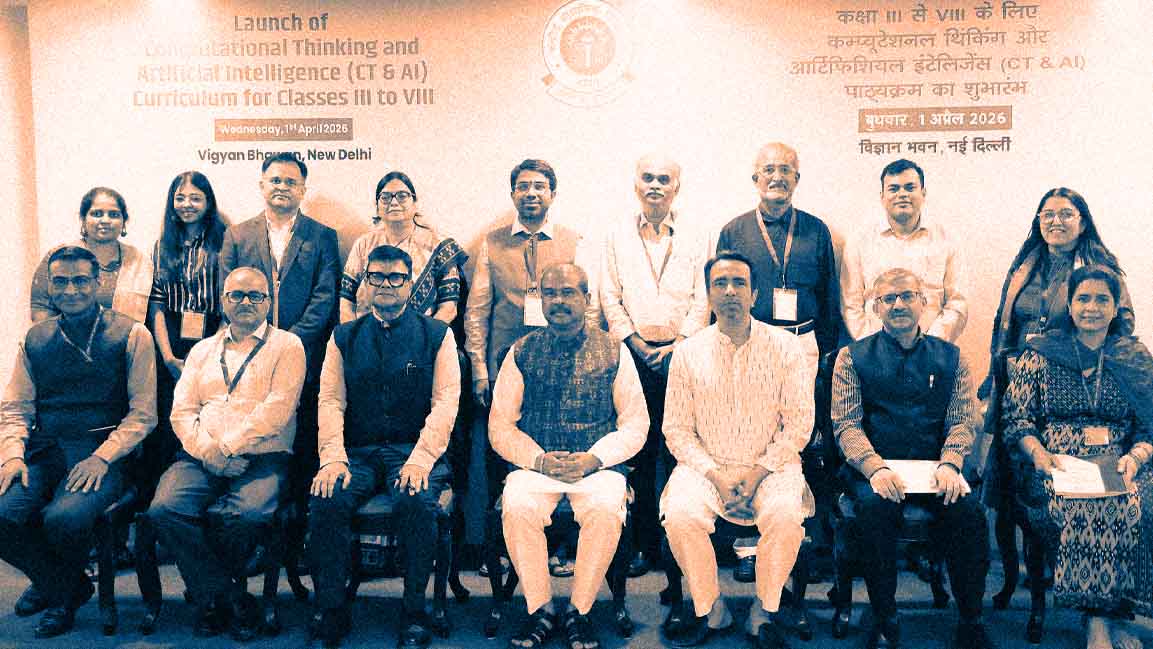
India’s Ministry of Education on Wednesday launched a new curriculum on artificial intelligence (AI) and computational thinking for students from Classes III to VIII, integrating it into the mathematics syllabus.
The curriculum will be implemented from the 2026-27 academic session and is aligned with the National Education Policy 2020 and the National Curriculum Framework for School Education 2023, according to the ministry.
The Central Board of Secondary Education (CBSE) said the program is designed to build “AI-ready learners” by strengthening foundational skills such as logical reasoning, problem-solving, pattern recognition and algorithmic thinking, while also promoting digital literacy and the ethical use of technology.
According to CBSE, the framework integrates computational thinking concepts directly into existing chapters of National Council of Educational Research and Training (NCERT) textbooks, including mathematics and The World Around Us (TWAU). To support implementation, the board has developed structured student modules along with detailed handbooks for both teachers and learners.
Union Education Minister Dharmendra Pradhan called the initiative a “transformative step towards future-ready learning,” emphasizing that it formally introduces structured AI education into India’s school ecosystem at scale.
In a post on X, Pradhan said the curriculum is backed by “structured modules, comprehensive teacher handbooks and robust student assessment frameworks,” ensuring early and systematic exposure to emerging technologies.
“Aligned with the vision of ‘AI for Education, AI in Education,’ it marks a decisive shift towards augmented learning—nurturing critical thinking, design orientation and a culture of innovation among young minds,” he wrote.
The curriculum has been developed by a specialized AI committee under the chairmanship of IIT professor Karthik Raman.
Pradhan said the initiative reflects India’s broader effort to integrate technology into education in a structured and contextualized manner. “Technology-driven computing has been accepted and integrated by India… India is only using AI now in a contextualised manner to be put in a structure,” he said.
To support the transition, the government has also prepared three core documents, including dedicated handbooks for teachers and students. These resources are designed to help educators not only deliver content but also incorporate AI tools into lesson planning and classroom engagement.
The move is part of a larger push to modernize educational infrastructure, including plans to replace traditional blackboards with interactive whiteboards. The ministry has also directed NCERT to collaborate with CBSE to translate the curriculum into regional languages to ensure wider accessibility.
“The road to development in our country is through the understanding of language,” Pradhan said, stressing the need for localization of content across states.
Union Minister of Skill Development and Entrepreneurship Jayant Chaudhry highlighted the urgency of adapting to technological change. “The illiterate of the 21st century are not those who cannot read, write but someone who can’t learn, unlearn and relearn. AI is already here, it’s not in the future,” he said.