
India Approves $13.2 Billion Plan to Widen Semiconductor Push
The second phase broadens government support from chip plants and packaging to equipment, materials, research, skills and Indian-owned intellectual property.
News
- L&T Group to deploy Microsoft 365 Copilot for 140,000 staff
- TCS Taps NVIDIA for Bengaluru Industrial AI Engineering Lab
- India Approves $13.2 Billion Plan to Widen Semiconductor Push
- Karnataka Plans State-Backed AI University
- IBM Says It Faltered as AI Spending Upends Enterprise Buying
- AI Use Rises but Engineering Depth Lags, Nasscom Study Shows
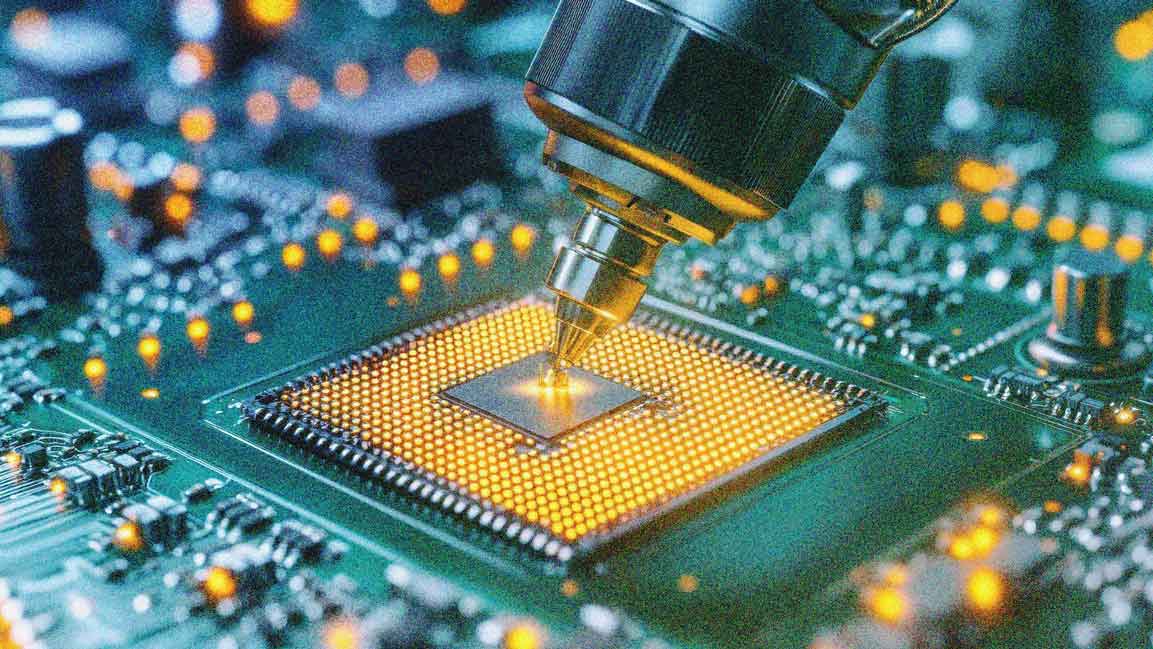
[Image source: Pankaj Kirdatt/MITSMR India]
The Union Cabinet approved a ₹1.275 trillion, or about $13.2 billion, semiconductor program on Wednesday, July 15, broadening India’s chip policy beyond factories and packaging plants to equipment, materials, advanced research and domestic intellectual property.
Semicon 2.0 will seek more silicon, compound-semiconductor and display fabs while supporting companies that manufacture chipmaking equipment, specialty chemicals, gases and other materials, the government said.
The program marks a shift in emphasis after the first phase focused heavily on attracting fabrication and assembly projects with government support of as much as 50% of project costs.
India has approved 12 semiconductor manufacturing projects involving more than ₹1.64 trillion of investment. They include one silicon fab, one silicon-carbide fab, an integrated gallium-nitride and MicroLED display facility and nine packaging plants.
Micron, Kaynes Semicon and CG Semi have begun commercial production, according to the government. Another approved plant is expected to start production this year, while the country’s first fab is scheduled to be commissioned in 2028.
Most of India’s early output comes from assembly, testing and packaging rather than semiconductor wafer fabrication. Semicon 2.0 seeks to fill gaps around those plants, particularly in machinery and materials that India still largely imports.
“ISM 2.0 rightly shifts focus from chip design to chip-making, where India’s real gap lies in equipment and materials that are still almost entirely imported,” CloudPhotonix Chief Executive Officer and Co-founder Tarun Sibal said.
Closing that gap would require specialist talent and sustained research partnerships, not incentives alone, he said.
The program rests on chip design, manufacturing equipment and materials, additional fabs, advanced assembly and packaging, research and development, and workforce training.
Design will remain a priority, with the government seeking more Indian ownership of chip and system intellectual property for strategic and commercial products.
Under the first mission, 24 semiconductor design projects from startups and small businesses received financial support. Another 105 companies gained access to electronic design automation tools used to develop chips and systems-on-a-chip for AI, telecom equipment, drones, satellite communications, surveillance cameras, smart meters and connected devices.
Vinay Shenoy, Managing Director of Infineon Technologies India, said the program showed policy continuity and could strengthen India’s position in chip innovation, particularly in technologies supporting decarbonization and digitalization.
The new phase will also support work on more advanced technologies. India’s current projects largely cover process nodes ranging from 28 nanometers to 110 nanometers, which are widely used in automobiles, power electronics, industrial equipment and consumer products.
The government said it would work with research centers in India and overseas on more advanced nodes.
Semicon 2.0 will also expand support for outsourced semiconductor assembly and test plants, known as OSATs, and assembly, testing, marking and packaging facilities.
The government wants to attract more advanced packaging technologies as chipmakers increasingly combine processors, memory and other components in a single package.
About 68,000 students at 315 universities have been trained in chip design using industry-standard tools, according to the government. The second phase will put more emphasis on clean-room operations, fab construction and manufacturing skills.