

PM Calls for Human-Centric AI at India Summit
Modi framed his call within the M.A.N.A.V. principles, arguing that artificial intelligence must remain accountable, sovereign and accessible if it is to serve the global common good.
News
- Fired OpenAI Researchers Warn Dismissals Could Chill Safety Work
- ARTEX Developer Closes AI Hacking Tool After Bank Attacks
- AI Redraws Global Race for Quant Talent as Coding Tools Lower Entry Barriers
- AI Dispatch | India Draws Billions Into AI
- AI Bots Now Make Up Half of Traffic to US Fed’s FRED Database
- Musk Blames ‘Oligarchs’ For Delay in Starlink’s India launch
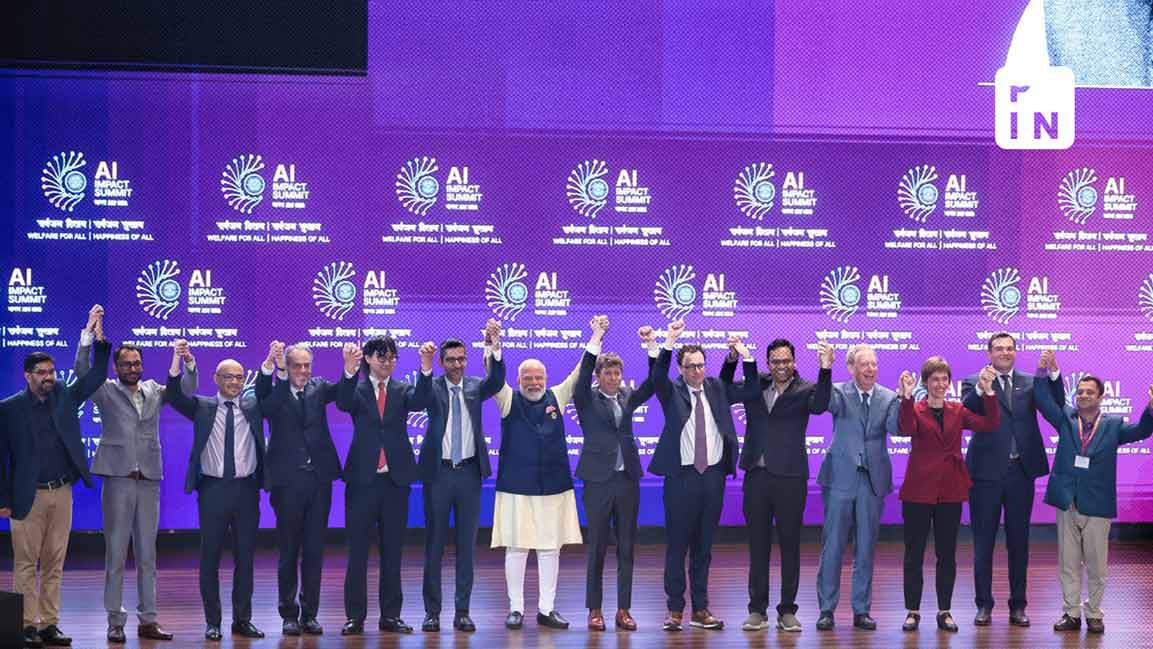
Prime Minister Narendra Modi on Thursday outlined a human-centric vision for artificial intelligence, urging governments and technology firms to work together to ensure the technology expands opportunity rather than narrows it.
Modi outlined what he called the M.A.N.A.V. framework for AI: Moral and Ethical Systems, Accountable Governance, National Sovereignty, Accessible and Inclusive, and Valid and Legitimate. The framework, he said, should guide AI’s development in the 21st century.
The prime minister stressed that AI must be democratized and serve as a tool of inclusion, particularly for the Global South. The world, he said, is entering an era in which humans and intelligent systems will “co-create, co-work and co-evolve.”
Calling for AI to serve the “Global Common Good,” Modi said India sees in artificial intelligence “the blueprint for tomorrow.”
Macron Warns of Strategic Competition
Speaking ahead of Modi, French President Emmanuel Macron cautioned that AI is becoming a field of strategic competition, referring to recent initiatives by the US and China.
“Big tech has gotten even bigger in the process,” Macron said.
“AI, GPU, chips are now directly translated in geopolitical and macroeconomic terms,” he added. “Some time for the best, some time for the worst.”
Macron pointed to India’s digital transformation, including its digital identity and payments systems, and said the country had built infrastructure “no other country has built, a digital identity for 1.4 billion people.”
He described AI as “an enabler for our humanity to innovate faster” across healthcare, energy and agriculture, and said India and France share that vision.
UN Calls for Global Guardrails
In his speech, United Nations Secretary-General António Guterres said the summit’s message was to ensure that “Technology improves lives and protects the planet.”
“The future of AI cannot be decided by a handful of countries or left to the whims of a few billionaires,” he said.
Guterres said the UN General Assembly had created an independent international scientific panel on AI comprising 40 experts, and launched a global dialogue on AI governance within the UN system.
“AI must belong to everyone,” he said.
“We need guardrails that preserve human agency, human oversight and human accountability.”
He also called for the establishment of a global AI fund to support developing countries. “Our target is $3 billion for this fund, which is less than 1% of the annual revenue of a single tech company,” he said.
India’s AI Stack and Compute Push
Meanwhile, Electronics and Information Technology Minister Ashwini Vaishnaw said India’s strategy is built around five layers, including applications, sovereign models, compute infrastructure and energy.
“We are providing access to 38,000 GPUs at a very affordable rate for our startups, academia, researchers and students, and we will be adding another 20,000 GPUs to this common compute platform,” he said.
He said smaller, focused models could address the majority of use cases at lower cost.
In his keynote speech at the event, N. Chandrasekaran, chairman of Tata Sons, said the group is building what he described as India’s first large-scale data center optimized for AI training and inference, and is developing domain-specific chips for sectors including automotive.
Dario Amodei, chief executive of Anthropic, said advances since the 2023 AI safety meeting at Bletchley Park in the UK had been “absolutely staggering.”
“My fundamental view is that AI has been on an exponential curve for the last 10 years,” he said, adding that models could surpass “the cognitive capabilities of most humans for most things” within a few years.
Amodei cited opportunities to “cure diseases that have been incurable for 1000s of years” and lift billions out of poverty, while warning about misuse and worker displacement.
He said India has “an absolutely central role to play” in managing both the opportunities and risks, and added, “Anthropic would like to work with India on testing and evaluation of models for safety and security risks.”
Sundar Pichai, chief executive of Google parent Alphabet Inc., described AI as “the biggest platform shift of our lifetimes.”
“It is the biggest platform shift of our lifetimes. We are on the cusp of hyper progress and new discoveries that can help emerging economies leapfrog legacy gaps,” he said.
“To build AI that is truly helpful for everyone. We must pursue it boldly, approach it responsibly, and work through this defining moment together.”
Pichai said Google is expanding infrastructure investments in India, including subsea connectivity and compute capacity, and warned that governments must help prevent the digital divide from becoming an AI divide.
“We cannot allow the digital divide to become an AI divide that means investing in compute infrastructure and connectivity,” he said.
He added that AI would reshape the workforce, automating some roles and creating new ones, and said training would be critical.