
Rewire Organizational Knowledge With GenAI
Global companies making real headway with generative AI use it to surface and connect knowledge throughout their organizations. Learn how to lay the groundwork and reap the benefits in your organization.
Topics
News
- Fired OpenAI Researchers Warn Dismissals Could Chill Safety Work
- ARTEX Developer Closes AI Hacking Tool After Bank Attacks
- AI Redraws Global Race for Quant Talent as Coding Tools Lower Entry Barriers
- AI Dispatch | India Draws Billions Into AI
- AI Bots Now Make Up Half of Traffic to US Fed’s FRED Database
- Musk Blames ‘Oligarchs’ For Delay in Starlink’s India launch
Despite the enthusiasm around generative AI, many projects fall short of expectations and fail to deliver business value. In July, Gartner predicted that by the end of 2025, 30% of GenAI initiatives will have been abandoned after proof of concept. The problem is less about technology and more about knowledge: Organizational data remains fragmented, inaccessible, and underused by decision makers. Knowledge management poses a bottleneck, despite being recognized as a source of advantage.
The real opportunity of generative AI is not in automating tasks but in transforming how knowledge flows through work. Workflows in meetings, onboarding, customer interactions, and project delivery become knowledge-rich and adaptive when GenAI is embedded.
In our research with a dozen global organizations, those that made tangible progress — moving from experimentation to integration, with observable benefits — used GenAI to unlock and connect knowledge across the enterprise. They turned knowledge from a static repository into a living system that drives faster decisions and stronger collaboration. Let’s explore how this change unfolded and how other leaders can prepare to make it happen in their own organizations.
Embedding Knowledge in Workflows
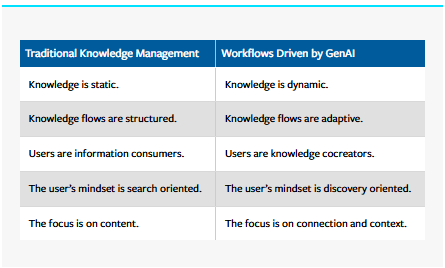
For decades, organizations have tried to get “the right insights to the right people at the right time.” Portals, intranets, and wikis promised to help, but they treated knowledge as static content to be stored and retrieved. Because these knowledge management systems sat outside of daily workflows, employees rarely used them.
Generative AI changes this dynamic. “GenAI provides an opportunity to embed knowledge into workflows in a seamless way,” said Julie Mohr, principal analyst at Forrester. “It enables organizations to work with knowledge as something dynamic that can be generated, adapted, and reconfigured in real time.”
This represents a shift in how we think about knowledge. It moves from being static to adaptive and embedded in action. Workflows are not just task sequences but conduits where knowledge is created, connected, and applied.
The contrast looks like this:
Rethinking Daily Work Processes: Two Examples
Organizations begin their GenAI journeys from different places, but those making tangible progress learn the same lesson: Value lies in transforming how knowledge is managed inside workflows. The Gates Foundation and Mott MacDonald, though very different organizations in terms of mission and structure, both illustrate how embedding generative AI into daily work requires rethinking the relationship between workflows and knowledge.
At the Gates Foundation, knowledge is the core asset enabling staff members to design and evaluate initiatives that will improve global health and reduce poverty. With such a knowledge-intensive mandate, one immediate GenAI opportunity lay in streamlining daily workflows. Meeting notes were the first target: Automating the capture of takeaways freed staff members to engage more deeply in discussions and improved note consistency. “Meeting-heavy organizations gain immediate value when notes are captured accurately and shared widely,” explained Andy Stetzler, the foundation’s enterprise AI lead.
Mott MacDonald, a global engineering and consulting firm, faced a different challenge. With knowledge dispersed across local offices and practices, leaders sought a unified knowledge base to support workflows across regions. “We’ve often had to move people around the globe to bring expertise to one place or another. But if you can securely share nonconfidential knowledge from a project with other sites, then a new project can start with all the insights already collected,” said Nasrine Tomasi, Mott MacDonald’s group head of AI. The company created a repository of more than 15,000 documents that were reviewed by subject-matter experts to confirm their accuracy, relevance, and currency. This single source of truth ensured that generative AI tools could operate reliably and that workflows would be drawing from verified insights, regardless of location.
Both organizations reached the same conclusion: GenAI’s impact came from preparing and connecting knowledge so it could be applied dynamically and widely, as opposed to using GenAI tools for one-off endeavors. The Gates Foundation focused on metadata hygiene and renaming “untitled” files and standardizing naming conventions to prevent garbage-in, garbage-out outcomes. At Mott MacDonald, a team of knowledge managers manually reviewed each document and added metadata not present in the text itself, such as approval status or regional applicability. “We spent a lot of time validating project learnings and methodologies so GenAI could work with them,” said group knowledge and information manager Zsuzsa McLean.
Together, these examples show how workflows give knowledge its movement, and knowledge gives workflows their intelligence. Generative AI succeeds when the two elements operate in tandem.
GenAI Rewires Knowledge Workflows in Four Ways
1. Remodel Knowledge Creation
GenAI can act as a cocreator, synthesizing new knowledge from diverse sources. At McKinsey, its internal generative AI tool, Lilli, gives consultants access to more than 100,000 documents, including ones from colleagues. Beyond retrieval, Lilli can use those documents and its training to generate tailored communications and write drafts that align with the firm’s standards. “It takes any prose and translates it into McKinsey-quality writing,” said senior partner Erik Roth.
The key challenge for McKinsey was embedding the tool into daily work. The goal was “to help colleagues access the deepest and broadest array of insights so they can activate them with clients,” Roth said. The solution was to make the process highly user-centric. A central team collected and prioritized use cases. Every improvement developers made, whether in the platform stack or a new capability, was based on user feedback and analytics. “There’s nothing in the pipeline that doesn’t tie back to user needs,” Roth said.
2. Unify Access Across Data Repositories
Codifying, organizing, and retrieving knowledge has always been difficult. GenAI enables workflows where employees can bypass fragmented systems and surface insights quickly.
At Evoke PLC, a betting and gaming company, its custom-built GenAI Studio tool — which was developed on AWS Bedrock and uses retrieval-augmented generation (RAG) — provides a secure, ChatGPT-like conversational interface that draws from multiple internal data repositories. “An employee looking for leave policies no longer has to dig through [multiple] documents. Now they can get the answer in one conversation,” said Vikas Diwvedi, global lead of AI transformation.
GenAI enables workflows where employees can bypass fragmented systems and surface insights quickly.
Delivering this experience to employees required extensive groundwork. Different functional units within Evoke had been maintaining separate repositories with overlapping or outdated documents, which led to version control and duplication problems. Before launching GenAI Studio, Evoke applied custom AI algorithms to identify and remove obsolete or redundant materials. By consolidating repositories and eliminating duplicates, the company could ensure that when the system answered questions, it would draw from accurate, current information. This cleanup made the conversational interface both reliable and trusted.
Mott MacDonald took a community-based approach to knowledge curation. Since 2017, Mott MacDonald has built global communities of practice supported by nearly 30 knowledge managers. Last year, these managers curated a repository of more than 15,000 documents, which now powers the company’s custom-built, RAG-based virtual assistant, called EMMA (Every Mott MacDonald Answer). Through EMMA, employees can quickly access best practices from more than 38 company practices, such as civil and structural engineering and environmental consulting.
“We are not going to go down the line of extensive tagging, because we hope AI can do that. We focus on curation, where human input is essential, like whether a document applies in the U.K., the U.S., or only certain regions,” McLean explained. The value of human curation lies in making implicit knowledge explicit. AI can parse and tag the obvious; humans must add the nuance. With a growing volume of content, EMMA still relies on humans in the loop to verify and approve materials, thus ensuring that the system remains both scalable and trusted.
3. Personalize Knowledge Transfer
A core challenge is ensuring that knowledge can move to where it is needed, particularly during onboarding, when new employees are eager to learn. At pharmaceutical firm Novartis, the question was how to accelerate that process without overwhelming newcomers. The company embedded generative AI in its HR systems so new hires could access role-specific policies and guidance through a conversational interface.
To coordinate similar initiatives, Novartis created the Knowledge Management Centre of Excellence, a team responsible for connecting the company’s knowledge management efforts and guiding the use of GenAI across business functions. The team is part of the People & Organization (HR) function but sits with a technology-focused group that reports to the chief people, technology, data, and insights officer. The group’s position gives it a full view of the employee life cycle, from onboarding to knowledge retention, plus direct access to the technical infrastructure needed to build AI-enabled tools. The arrangement helps bridge human and technological priorities.
4. Apply Knowledge in Daily Work
Applying knowledge is where business value is realized. Austrian insurer Uniqa Insurance Group integrated generative AI into customer service workflows through its infobot solution, an internal, RAG-based assistant that supports customer agents during live calls. The infobot automatically identifies the customer, pulls policy and tariff data from multiple back-end systems, and prepares detailed responses for the agent in real time. It also automates routine tasks, such as calculating benefits and generating call summaries, with one click.
This level of integration required deep attention to user behavior. The team worked closely with customer service agents, observing their work and identifying high-friction moments. “These kinds of mini features you only find when you really work with them,” noted Alexander Petzmann, Uniqa’s group data and AI excellence lead. “You ask, ‘What’s your next step?’ and ‘Where is your biggest pain [point]?’”
At the Gates Foundation, hackathons bring together groups of 20 to 75 employees to explore how agents or GPTs could be applied to specific functional workstreams, such as HR, finance, policy, and communications. “We’ve found these work best when teams come in with a focused use case,” explained Andy Stetzler, enterprise AI lead. For example, one idea that arose was an inclusive language assistant grounded in the organization’s inclusive language guide. Users are now able to upload emails, documents, or announcements, and the assistant provides recommendations to align content with inclusive and culturally sensitive standards.
Successes like Uniqa’s real-time integration of GenAI and the Gates Foundation’s experiments come from redesigning work so that knowledge is applied where decisions happen.
Taken together, these cases show that GenAI creates value not as a stand-alone tool but as an embedded element of workflows.
How to Lay the Groundwork at Your Company
As powerful as generative AI can be, leaders we spoke with across industries emphasized that its full potential depends on unglamorous work: preparing the organization’s knowledge and technology systems and readying for culture change. Without this groundwork, workflows cannot carry knowledge reliably. Time and again, executives told us that proofs of concept often fail because workflows are redesigned with GenAI, but the underlying systems and practices are not ready to support them. Leaders should focus on these five items to do this work successfully.
Start with visible pain points. Early success often comes from addressing pain points that are immediately obvious to employees, especially in knowledge-intensive areas. In our case studies, this was often where the friction was greatest. At the Gates Foundation, for example, automating meeting notes freed staff members to improve the consistency of work.
Realizing GenAI’s full potential depends on unglamorous work: preparing the organization’s knowledge and technology systems and readying for culture change.
Silvan Melchior, principal data scientist at Zühlke, a Swiss tech consultancy, emphasized that such use cases still need careful scoping. Leaders should evaluate each project along three dimensions: feasibility (can the data and systems support it?), viability (is there a business case?), and desirability (do people actually want it?). “If a bot only answers a question once a week, there’s no use case,” he explained. Applying this discipline ensures that organizations invest in initiatives that matter in people’s daily work and reshape workflows in ways that employees value.
At Mott MacDonald, adoption spread through communities of practice and the dedicated team of knowledge curators, who supported practitioners. As staff members saw the value of reliable answers, they began requesting that more content be added, turning adoption into a demand-driven process reinforced by credibility and usefulness.
Together, these experiences show that adoption grows when employees see GenAI as credible and valuable in their daily work, see leadership support the initiative, and have access to learning opportunities and trusted champions who bridge technology and practice.