


How Nesting Changes Platform Strategy
Should your platform host another platform — or be hosted by one? Here’s how to think through the choices.
News
- Fired OpenAI Researchers Warn Dismissals Could Chill Safety Work
- ARTEX Developer Closes AI Hacking Tool After Bank Attacks
- AI Redraws Global Race for Quant Talent as Coding Tools Lower Entry Barriers
- AI Dispatch | India Draws Billions Into AI
- AI Bots Now Make Up Half of Traffic to US Fed’s FRED Database
- Musk Blames ‘Oligarchs’ For Delay in Starlink’s India launch

When one of us, a longtime Spotify user, set up her new Sonos speaker, the Sonos app prompted her to link music services. With a quick login, she was able to connect her Spotify account to Sonos. Suddenly, Sonos became her go-to gateway for music at home. Spotify, once her primary music platform, became relegated to a secondary role within Sonos’s ecosystem. While this arrangement is convenient for the user, it has strategic implications — both challenges and opportunities — for the companies involved.
We refer to an arrangement where one platform embeds into another platform’s user experience as a nested platform. The host platform gains partial or total control of the customer experience. The nested platform provides an embedded experience. User experiences span both platforms, which aim to create value for users while increasing their own strategic advantage. A host may choose to allow multiple platforms to nest into it: Amazon Music, Apple Music, Spotify, and other streaming services are all nested into the Sonos platform. Similarly, a nesting platform may choose to nest on multiple hosts; for example, Spotify also nests into other hardware platforms, such as Amazon devices that use its Alexa virtual assistant. Further, platforms may choose to nest in some cases and host in others. Spotify, for example, nests into Sonos’s app but also has its own Spotify Connect interface, which allows it to function as a host with device platforms nesting into it.
These nesting structures have implications for the business models of participating platforms. Along with the advantages, there are trade-offs on both sides. A nested platform gains expanded reach by joining an ecosystem that already has its own customer base, helping to drive the network effects that enable the nested platform to keep growing and remain viable. Yet it also cedes some control of its own ecosystem, customer experience, data, and brand visibility to the hosting platform. A hosting platform gains additional capabilities and features for customers, along with access to new markets and complementor ecosystems, but it also provides potential competitors with an entry point to its customers.
Our interviews with executives of both host and nested platform companies reveal key questions businesses should ask if they’re considering pursuing this strategy: Is access to new markets worth losing some control of customer relationships? How can platforms safeguard their market positioning, customer experience, brand, data, and margins when giving another platform access to their customers and complementors?
As platform ecosystems mature, it is increasingly vital that companies understand nesting strategies for competitive differentiation and ecosystem growth. In this article, we highlight key strategic choices for managers when developing a nesting platform strategy and offer guidance on how to analyze trade-offs. We explore how both hosting and nesting companies can effectively harness complex networks of interconnected relationships to expand their platform’s reach and grow their business while mitigating accompanying risks.
How Nested Platforms Create Value
Platforms facilitate exchanges between interdependent and complementary groups of users.1 They often act as matchmakers, bringing together producers and consumers or connecting users with each other. They are frequently powered by cross-side network effects: The more users on one side, the more valuable the platform becomes for the other side, and vice versa.2 In Spotify’s case, as more artists join the platform, it attracts more listeners, in turn drawing even more artists. Some platforms have same-side network effects thanks to large, engaged user communities. Spotify listeners create and share playlists, creating more value for each other; the larger the listener community, the more valuable it becomes for any individual.
Nesting one platform within another can be a powerful strategic move for both hosts and nesters: As we noted, a smart-speaker company like Sonos wants to offer customers access to a broad array of audio content, while Spotify needs to ensure that its customers can listen to its audio streams wherever they like. Nesting is also a way for smaller platforms to enter markets. For example, when emerging platforms nest into Asian super-platforms like WeChat and Alipay, they catalyze new growth for both nesters and hosts.
When nesters embed their offering in a host platform, it helps them reach new users and may fuel additional network effects as the feedback loop attracts even more complementors. For instance, by nesting into Kayak, Justfly.com, a smaller player, gains exposure to Kayak’s much larger traveler user base, which helps it grow its platform. Kayak, the host, benefits from offering more flight options and deals, potentially attracting and then retaining more users. For both companies, nesting boosts visibility, bookings, and customer acquisition and satisfaction. These network effects can introduce new or amplified feedback loops between user groups and complementors, and across ecosystems, which can be especially powerful in nested platforms.
As a platform’s ecosystem grows, curation and governance become more complex.
We increasingly see platforms nesting within other nested platforms, creating chains, or webs, of platforms. (See “Nested Platforms Take Many Forms.”) For example, when the Android Auto and Apple CarPlay platforms nest within cars’ built-in electronics and display systems, users can access smartphone apps via the automotive infotainment systems, which are acting as host platforms. Some of the apps are themselves platforms, such as Spotify or the Waze navigation system, which connects drivers as they observe and share real-time road conditions. When a driver connects a smartphone to a car, a subset of the phone’s functionality becomes available on the car’s display through the vehicle’s infotainment system. The driver can see the phone’s menu and the car’s platform at the same time.
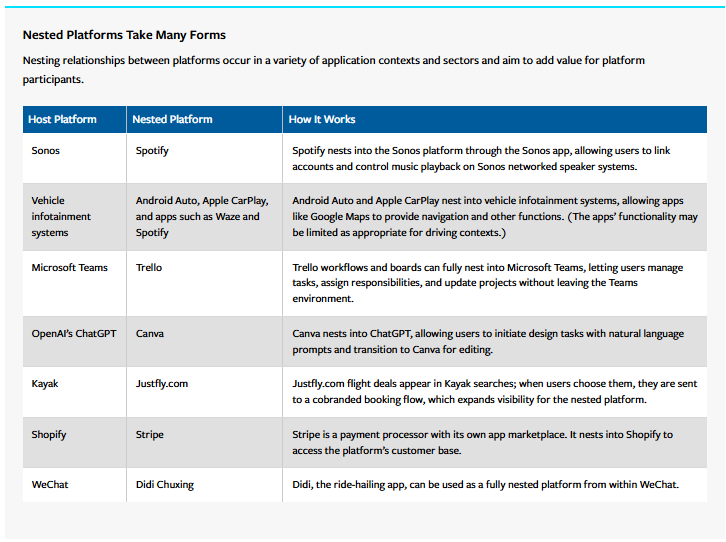
Key Decision Points for a Nesting Platform Strategy
If you’re considering entering a nesting relationship with another platform, you must make numerous strategic decisions, including what position to take in a nested relationship, how many such relationships to engage in, and which markets to address. You must weigh potential risks and challenges and evaluate necessary capabilities. And once you’ve identified the potential to have nesting relationships, you must determine how close the relationship should be and how the parties will handle data access and data sharing. Below, we review the key questions you should ask and offer guidance for thinking through them.
1. Should we host, nest, or do both? Your business strategy and existing relationships with customers, competitors, and partners are the starting point for your decision about whether to participate in a nesting structure and, if so, which role to take. Hosting often supports expanding your company’s market presence and offering a broad range of services without building new platform capabilities. Nesting allows platforms to participate in markets that are beyond their current scope.
Which role you should play in a nesting structure might be more obvious in some cases than in others. If your platform would benefit by having another synergistic but distinct platform nested into it, you should be a host. If your platform is one part of a larger offering, such as an infotainment system in a car, and being a platform isn’t your organization’s strongest suit, then becoming a host and enabling other platforms to offer additional services to your customers might be a very good move.
A rationale for hosting is to become the focal one-stop shop for customers. By allowing Trello and other services to nest within its platform, for example, Microsoft Teams enables users to manage tasks and assignments without switching apps, thus reinforcing Teams’s position as a multifunctional productivity hub. Hosting can also strengthen a platform’s relevance by offering complementary services that extend beyond its original scope, as WeChat has done extensively in China.
If your platform could benefit from reaching a wider audience or addressing complementary markets, then becoming a nester might make the most sense. This is especially true for platforms operating in an industry closely aligned with another, such as restaurant reservations and transportation. Uber has announced a “dine out” feature in its UberEats app, available as of this writing in Australia, that allows diners to access reservations through OpenTable. Thus, OpenTable is nesting within UberEats. Hard-to-access reservations are available for premium users, providing customers with an incentive to adopt the nested solution.
For some companies, the decision to be a host or to nest is not as clear, and the solution might be to do both. If your platform users access your service via various means, it may make sense to both host and nest and to provide many ways to engage with your platform.
2. How may nesting relationships affect our governance? As a platform’s ecosystem grows, curation and governance become more complex and more risky. These concerns are amplified in the nested platforms context, since nested platforms themselves have curation and governance structures managing their own ecosystems of complementors and users. These structures may be inconsistent with those of hosts, resulting in conflict.
Nested platforms’ policies may be more or less stringent, with some allowing very open access (with less concern about managing quality) and others having strict curation with tight quality requirements. As a host, what challenges might you encounter if your nested platforms allow complementors that offer low-quality products or services? To what extent might this affect your reputation? If you establish stricter curation policies, to what extent might that affect your ability to attract nesters? Is it problematic for you competitively if nested platforms allow complementors that have services that compete with yours? Might it cause issues as you compete in your own markets? In sum, if you are acting as a host, establish quality standards and vetting mechanisms to evaluate whether the governance policies of potential nesting platforms are consistent with your standards. As a nester, consider the consequences of modifying your approach to platform governance as you start joining hosts’ platforms and aligning with their policies.
3. How might our resource requirements and costs be affected by nesting? While hosting may be an efficient way to provide customers with new services, it is likely to add new resource requirements and costs. Do you need to acquire specific skills to manage a nesting structure (such as more business development people versed in ecosystem management)? Similarly, while becoming a nester may be an efficient way to access new markets, it also may require additional resources and add costs.
Whether your platform is a host or a nester, integration work is required. A relatively straightforward way to accomplish this is via an open API. Hosts can make APIs available and allow nesters to access them mostly independently. However, in some cases, an open API may not address hosting requirements either for technical or strategic reasons. For example, if you are hosting your competitors, you might want to negotiate each relationship individually to create tailored and mutually beneficial agreements. In these cases, given the wide range of nesting platform types and business needs, scaling is difficult. Adding more nesting platforms can require significant additional resources, including engineers, business development managers, marketing and branding experts, and others.
4. Does a nesting relationship expose us to competition or brand conflict? While nesting provides access to more customers, it can also expose platforms to direct competition. Amazon Music, Spotify, and other music services appear side by side on the Sonos app, allowing customers to easily compare competitors. A service may nest into a platform that, although it starts as a collaborator, could become a competitor over time through disintermediation or just by growing much larger.
Another strategic consideration for hosts is branding. All platforms worry that a complementor could tarnish their brand, so they employ explicit guidelines and community practices to address these concerns. The risk mushrooms with nested platforms because each one brings its own complementor ecosystem with accompanying brand risk exposure.
When your service sits alongside others with stronger branding, your distinctiveness may be at risk. Whether you’re considering hosting or nesting, clarify what makes your platform uniquely recognizable and attractive to users and complementors. What policies, including those that are technological, contractual, or marketing-related, will preserve your brand and your ability to differentiate and maintain customer loyalty in a nested structure?
5. Do we gain new technological capabilities by nesting? Nesting can be a shortcut to accessing new technological capabilities. Instead of building a feature, a platform can nest within another platform that already offers that feature. Canva nested its design platform into the ChatGPT platform so that Canva can take advantage of the user-friendly large language model interface and AI suggestions without having to develop its own. Nesting also benefits ChatGPT, because offering advanced design generation via Canva extends its utility.
Consider what technological capabilities you need in order to accomplish your mission but lack the resources to develop or acquire. Is there a nesting relationship that could add these to your platform?
6. How tightly should we integrate, and how much functionality should we offer? Another key strategic consideration is the extent to which nesting and host platforms are integrated — that is, how do consumers access nested services? And how much functionality should a nested platform offer? How much functionality should a host even allow? These decisions affect business outcomes and customer experiences. They result in interactions ranging from light-touch engagements to deep and thorough integrations, reflecting the notion of nesting intensity.
While nesting provides access to more customers, it can also expose platforms to direct competition.
In contrast, in cases of very tight and comprehensive integration, a user stays within the host platform and experiences the nested platform within the host environment. This is the case with Trello nested within Microsoft Teams, or food ordering and delivery platforms nested into Google Search and Maps. Here, the customer never has to leave the Google page where they’ve located the restaurant they want to order from, and they can directly access their delivery app of choice.
While close integration has the benefit of a single integrated user experience, it does come with risks. The nester loses some control of the quality of the user experience and may even cede ownership of the customer to the host platform. To address these concerns, some nesters take a hybrid approach. Spotify, for instance, provides users with the option to either go directly to Spotify through a redirect link from Sonos or use the embedded version of Spotify within Sonos. Spotify managers recognized that having customers remain within the Sonos app reduced their level of control and customer engagement. Sonos agreed to include the redirect link because of the value of having Spotify as a nested platform. Market power matters in these relationships.
How much functionality to allow or provide may be a more nuanced question. In some instances, a nesting platform may offer full functionality within the host’s interface. In others, a nesting platform may end up with a lower level of functionality, either by choice or to accommodate a host’s requirements. In most cases, there is some reduced functionality when a platform nests into another platform. For hosts, keeping nesters as lesser services with more constrained functionality reduces risk, including the risk of user experiences becoming too complicated.
As previously noted, an automotive system may need to limit the functionality of nesting platforms to ensure that people drive safely. A nester may also limit functionality so that the host does not disintermediate it by taking over customer relationships. This setup provides users with reasons to still access the nester’s stand-alone service even though there is also a nested instantiation. For instance, when listeners use Spotify embedded within Sonos, they can’t modify playlists; to do that, they must use Spotify’s stand-alone platform. Similarly, a former Sonos manager explained that when Spotify acts as a host through its Spotify Connect interface, Sonos users cannot group or ungroup rooms or independently control room volumes. To access full Sonos functionality, users need to return to the Sonos app. Limiting functionality in this way, however, risks frustrating or confusing users, since they may need to access apps via multiple routes to gain the full product and service benefits.
As you consider what the appropriate level of nesting intensity might be for your strategy, there are a few factors to consider. How concerned are you about losing direct control of customer relationships? If this is a major concern, then you may want to strategically limit functionality to preserve your stand-alone value proposition and protect customer relationships. Navigating nested structures can be confusing to customers; continue to review user experiences, noting potential frustration points. Where there is friction, consider which nesting decisions to revisit. Would allowing more functionality or simplifying the user experience address the issues?
7. What data can be collected, accessed, and shared? To what extent will hosts and nesters allow each other to collect, see, and share data? Data is essential to operational effectiveness of all platforms, including how platforms match participants such as buyers and sellers. It is critical for monetization; platforms sell advertisements and attract complementors with data access and analysis. Further, with the increasing prevalence and importance of AI systems, proprietary training data is an important source of competitive advantage. Nesting platforms bring their own transactional, behavioral, and outcome data that could be extremely valuable to hosts, especially if they are both operating in the same or complementary industries. But nesters may be hesitant to share data for fear of being disintermediated or creating a strong competitor. What to share and in which form are key strategic decisions for nesting platforms. For hosts, determining what to require of nesters is the flip side of the same question, and it carries similar opportunities and challenges.
While close integration has the benefit of a single integrated user experience, it does come with risks.
It is critical that nesting platforms understand which entities will have access to their data and what constraints will be placed on the use of that data. A nesting platform may not allow all of its customer data to be shared with a host platform; more powerful nesting platforms may have greater leverage with hosts. For instance, Sonos does not receive listening data (what customers are playing and for how long) from at least some of its nested services. This is because streaming services use listening data for monetization and to gain strategic advantage over their competitors; it is one of their most valuable proprietary assets. But in cases where the host has more power, it may require a nested platform to provide user behavior and transaction data. A host may be able to aggregate data from various nested platforms, gaining insights more valuable than those that a single platform without nesters could acquire and leverage.
When hosts aggregate data across nested platforms, they may also strengthen network effects. For example, they can improve discovery, personalization, and recommendations by integrating individualized data across platforms. This can make the host more central to user experiences, which can attract more users and complementors.
You must define your data access policies because of the trade-offs involved. Based on power dynamics, risk, and strategic value, proactively determine what data you need to collect and use and what you are willing to share. For example, a navigation platform may choose not to share destination data with its nested platforms, since this data may be considered sensitive by users and sharing it could erode trust.
You must also specify which data is collected, who collects it, who accesses it, and how it flows across nested relationships. This forces both host and nesting platforms to provide transparency and accountability to each other and participants on their platforms. This, in turn, helps to ensure that host and nesting platforms comply with data policies and regulations, especially around data privacy and security.