Employee Data is Your Biggest Asset and Your Biggest Liability
The richest dataset in any company is how its own people work. Collecting it, as Meta discovered, is also the fastest way to lose their trust.
Topics
News
- Fired OpenAI Researchers Warn Dismissals Could Chill Safety Work
- ARTEX Developer Closes AI Hacking Tool After Bank Attacks
- AI Redraws Global Race for Quant Talent as Coding Tools Lower Entry Barriers
- AI Dispatch | India Draws Billions Into AI
- AI Bots Now Make Up Half of Traffic to US Fed’s FRED Database
- Musk Blames ‘Oligarchs’ For Delay in Starlink’s India launch

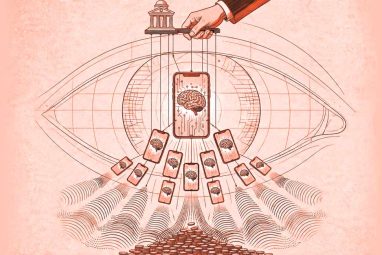
Image Credit- Chetan Jha/ MIT Sloan Management Review India
Key Takeaways
01
A program Meta built to train its AI on how employees work,left their tax and medical records open across the company, and was paused on 22 June.
02
Layoffs are not paying off. Gartner found that firms with strong AI returns cut staff at nearly the same rate as firms with weak ones.
03
India has the most at stake. With the DPDP Act binding employee data and NITI Aayog projecting a 1.5-million-job downside, how firms govern this data is now a boardroom call.
A Meta program spent this spring quietly logging how its employees worked, down to every keystroke and mouse twitch. The trouble surfaced when staff opened their own laptops and found the same system had left tax records, medical files and private messages out in the open, readable across the company. On Monday, 22 June, Meta pulled the plug.
The tool had a name, the Model Capability Initiative, and a job. Since April it had been recording the clicks and keystrokes of US employees to train the company’s AI models. Meta filed the leak as a high-priority security incident and said it would pause while it investigated. As of that Monday afternoon, Reuters reported, the software was still recording.
The embarrassment will fade, but the question under it will not. Companies have started to treat the daily labor of their employees as the raw material for AI to perform that labor, and Meta has just shown what happens when that material gets loose. It does not sit politely on a server. It escapes, and on the way out it takes trust with it.
India has more riding on the answer than almost anyone. Its software and back-office firms employ millions in exactly the process-heavy desk work that AI is learning to do, and its new privacy law treats the kind of bulk collection Meta attempted as a legal exposure rather than a routine perk of running a company.
Work Itself Has Become the Training Data
Large language models learned to write by reading the internet. Agents built to do actual jobs need something the internet does not hold: a record of how those jobs get done. That record turns out to be everywhere. It lives in closed tickets and half-saved spreadsheets, in the Slack thread where a decision got made and then quietly unmade. For years it stayed locked inside enterprise software, of interest to nobody but auditors. Now companies want it badly.
Meta was unusually blunt about why. An internal memo seen by Reuters described the aim as teaching its models the things software still fumbles with: navigating interfaces, using keyboard shortcuts, and making the small operational calls that fill a working day. Employees would supply the lessons simply by showing up to work.
The ambition is starting to take physical shape. At its Build conference on 2 June, Microsoft Corp. unveiled Project Solara, a platform for devices that run AI agents in place of apps. One prototype is a badge, worn on a lanyard like the ID card it means to replace, that lets a worker hand a task to an agent and watch it run. The job, in that version of the office, is no longer to do the thing. It is to supervise the software that does.
The appetite for this data has spun up a small industry. In India, a firm called Objectways pays people to strap on head-mounted cameras and motion sensors and then go about ordinary chores, cooking, cleaning, and moving objects around a room. The rate runs to about ₹250 an hour. The footage trains AI systems and the humanoid robots that may one day do the cooking instead.
None of this needs to involve watching employees at all, argues Animesh Samuel, who co-founded and runs E42.ai, a no-code platform for building what it calls AI co-workers. “The AI co-workers need only be trained on the inputs and outputs to deliver outcomes,” he says. He points to his own accounts payable agent as proof. “One of our AI coworkers for accounts payable was trained using invoices, workflow rules and connections to the company’s existing business software. It learned from the process itself rather than from monitoring employees, and that was enough for it to perform effectively.”
Train on the process and you have built a tool. Train on the person, as Meta found out, and you have collected a problem you cannot uncollect.
“The hard risk is disclosure shock. Employees who learn after the fact experience it as betrayal, not business. People who feel mined rather than consulted become a threat surface.”
— Sagarika Chakraborty, CEO India & Gulf and Global Head of Investigations, IIRIS Consulting
The Data Grab Fails Before It Pays
Start with security, since that is where Meta’s program broke first. A system designed to soak up how people work is, by its nature, a system sitting on a great deal of sensitive material, and the more it holds the more there is to spill. Reuters reported in May that MCI was gathering more than Meta had let on and storing some of it unencrypted. The June leak was the bill arriving.
Sagarika Chakraborty, who runs investigations for India and the Gulf at IIRIS Consulting, has watched this go wrong from the inside. Technology is rarely the problem, she says. The rollout is. “The hard risk is disclosure shock,” she says. “Employees who learn after the fact experience it as betrayal, not business.”
What follows is less an explosion than a slow rot. People stop sharing what they know, guard their work, and slow-walk the handover. Some leave. A few, she warns, turn into something worse. “People who feel mined rather than consulted become a threat surface,” Chakraborty says.
The fix is dull and well known, which is to tell people first. Ayaskant Sarangi, the chief human resources officer at Mphasis, treats it as nothing new. “Employee voice has always been central to good HR practice, and this is no different,” he says. “As AI becomes more embedded in how organizations operate, keeping employees informed and involved in those decisions isn’t just ethical, it builds the trust that makes transformation sustainable.”
Workers are not paranoid to join the dots. The cuts have been steady and loud. Amazon shed about 16,000 corporate jobs on 28 January, its second round in three months. Back in November 2025, HP said it would drop 4,000 to 6,000 people by 2028 as it leaned harder into AI. Meta let go of roughly 8,000, about 10% of its staff, in May. Snap cut around 1,000 in April and mentioned, almost in passing, that AI now writes more than 65% of its new code. Block, Jack Dorsey’s company, cut more than 4,000 in February and pinned the decision squarely on AI.
Even the firms building the technology have begun bracing for the fallout. OpenAI set aside $250 million in late May to study what AI does to the economy. Anthropic followed on 11 June with $200 million and an essay from its chief executive, Dario Amodei, warning that this disruption could run deeper and longer than the ones before it. “The key challenge in such a world won’t be incentivizing growth, but finding a way for everyone to share in the benefits,” he wrote.
Then comes the part that should stop the cost-cutters cold. On 5 May, Gartner published a survey of 350 executives at billion-dollar companies, conducted in the second half of 2025. Around 80% had reduced headcount after deploying automation. But the firms reporting strong returns were cutting at nearly the same rate as the firms reporting none. The layoffs, by this reading, were not where the gains came from. “Workforce reductions may create budget room, but they do not create return,” the Gartner analyst Helen Poitevin said.
Which leaves a strange bargain at the center of the whole project. Companies are mining their workers to build the tools meant to replace them, and so far the mining corrodes trust while the replacing fails to pay for itself.
India’s Test Is Governance, Not the Model
India has more at stake here than almost anyone. Its IT services and back-office sectors employ millions, many of them in desk-bound, process-heavy roles that today’s AI can most easily absorb.
The NITI Aayog put a number to that risk in October 2025. Its Roadmap for Job Creation in the AI Economy laid out two possible paths. Without a serious push on skills and infrastructure, India could lose up to 1.5 million technology jobs by 2031. With the right investments, it could add as many as 4 million, taking tech employment close to 10 million.
Technology does not settle that question by itself. Policy, training and management choices do. “The question is no longer if jobs will be impacted, but how we respond,” said Debjani Ghosh, a distinguished fellow at NITI Aayog.
India’s privacy law adds another layer. The Digital Personal Data Protection Act, which governs how companies handle personal data, does not give employers a free hand to treat staff information as raw material for every new AI system. Consent matters. A Meta-style approach of collecting first and dealing with sensitivities later would face legal and reputational risks in India that are easier to ignore in the United States.
That is why Indian companies cannot leave workplace data for some later governance clean-up. Meta’s MCI program is useful precisely because it shows how quickly the risks can build.
WHAT META’s MCI PROGRAM SHOWS
Stage | What happens | In Meta’s case |
Extraction | The firm starts harvesting how people work. | MCI began capturing keystrokes and mouse movements from US staff in April 2026. |
Exposure | That haul turns into a security liability. | By May, Reuters found it storing data unencrypted; by June, the records sat open to the whole company. |
Erosion | Trust goes, and people pull back. | A staff petition, a security report, and a full pause, all within roughly 10 weeks. |
The good news for Indian firms is that none of those stages is fated. Train on the process instead of the person, the way E42 does, and there is little worth stealing in the first place. That approach lowers the sensitivity of the data being collected. Where personal or behavioral data is still needed, it can be encrypted, restricted and logged rather than left broadly accessible. And the disclosure that Ayaskant Sarangi of Mphasis and Sagarika Chakraborty of IIRIS Consulting both stress is not expensive. It only requires companies to tell employees what is being collected, why it is being collected and who can see it.
Meta managed to fail at all three inside about ten weeks. Nobody is obliged to copy the homework.
Implications by Role
C-suite | For a chief executive, a data-collection program is now a governance decision dressed up as a technical one. Meta’s reputational hit and security scramble both landed well before any payoff from the data did. Ask the plain question before the next rollout. What exactly are we collecting, and what is it for? A fuzzy answer means the program is not ready. |
Functional leaders | Heads of HR, IT and data carry the most concrete work. Audit what is being gathered, where it lives and who can reach it. Meta’s trove was both unencrypted and visible across the company, a pairing no functional owner should ever waive through. Consent and disclosure belong in the design, not in the apology that follows the breach. |
Boards and governance | Boards should file employee-data leaks alongside the financial and cyber risks they already lose sleep over. The questions are not exotic. Where does staff data feed our AI? What does the DPDP Act expose us to if it spills? And who, by name, answers for it when it does? |
Who Earns the Right to Keep the Data
The workplace has become one of the richest datasets any company holds, and one of the easiest to turn against itself. The firms that come out ahead will not be the ones that captured the most about how their people work. Collect everything, and you may find you are trusted with nothing.
MIT Sloan Management Review’s AI Research Forum will make its India debut later this year, bringing together enterprise leaders, researchers, and practitioners to examine how autonomous AI is moving from experimentation to governed deployment at scale. To speak, partner, or attend, register here.
Research Highlight
This article draws on interviews with Animesh Samuel of E42.ai, Ayaskant Sarangi of Mphasis and Sagarika Chakraborty of IIRIS Consulting. It is supported by Gartner’s survey of 350 executives at billion-dollar firms, published 5 May 2026, NITI Aayog’s October 2025 AI jobs roadmap, and Reuters reporting from May and June 2026 on Meta’s paused program.
Topics
About the Author
Shivani Tiwari is a Correspondent at MIT Sloan Management Review India, covering AI, cybersecurity, and the people and companies shaping the future of technology.
View More